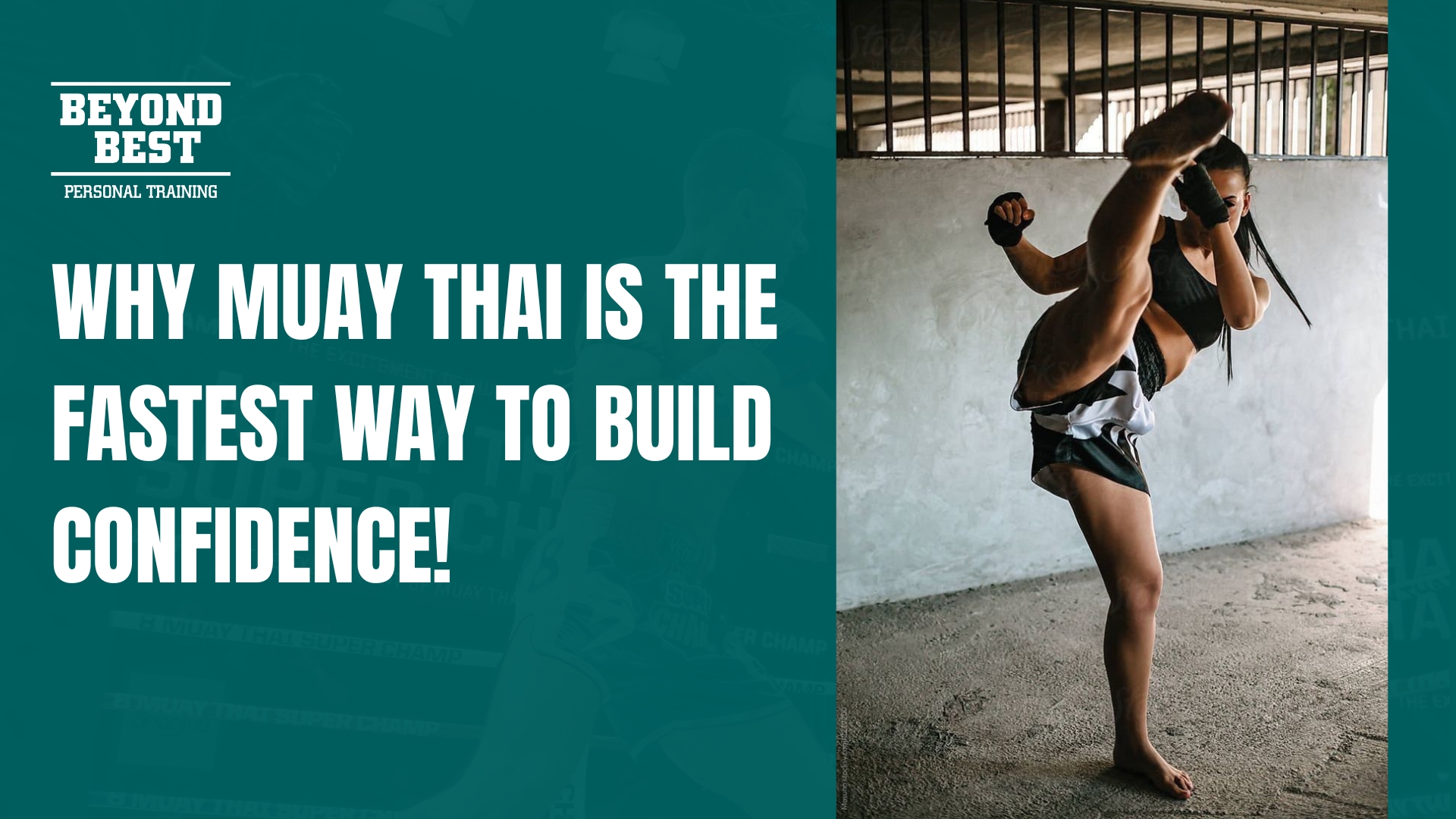
Confidence isn't something you can think your way into. You can read every self-help book on the shelf, repeat every affirmation in the mirror, and still walk into a room feeling small. That's because real confidence isn't built in your head; it's built in your body, through proof. And there's no faster way to accumulate that proof than stepping onto a Muay Thai mat.
Confidence Is Evidence, Not a Mindset
Most people think confidence is a feeling you either have or don't. In reality, it's a track record. Every time you do something hard and come out the other side, you gather evidence that you're capable. Muay Thai manufactures that evidence at a pace almost nothing else can match.
Your first session, you might not land a clean combination. By week four, you're holding pads for a partner and calling out combos with authority. By week twelve, you're sparring, genuinely testing yourself against another person, reading their movement, and trusting your own reactions under pressure. That's not a metaphor for confidence. That is confidence, built rep by rep.
This isn't just a nice idea. Research comparing martial artists to non-martial artists has found a significant relationship between martial arts training and confidence, with practitioners showing notably higher physical, ethical, and intellectual confidence than other athletes. Researchers concluded that martial arts training strengthens self-concept and self-efficacy in a way that carries into everyday life (Alesi et al., 2014).
It Trains the Nervous System, Not Just the Body
A big part of what we call "confidence" is really nervous system regulation, the ability to stay calm and think clearly when things get intense. Muay Thai puts you in controlled, low-stakes versions of high-stakes situations: someone is coming at you, your heart rate spikes, and you have to respond rather than freeze.
Do that enough times in the safety of a gym, with a coach guiding the intensity, and your body learns a new default response to pressure. A meta-analysis of martial arts practitioners found that the mental dimension of self-management, things like emotional control and focus under stress, had a particularly large effect on exercise self-confidence (Kim & Cruz, 2021). That skill doesn't stay on the mat. It shows up in job interviews, hard conversations, and everyday stress, because you've physically practised staying composed when things get uncomfortable.
Physical Competence Changes How You Carry Yourself
There's a reason posture and body language are so tied to how confident someone appears, and feels. Muay Thai builds strength, coordination, and body awareness in a way that's immediately visible. Students often notice they stand taller, move with more purpose, and take up space differently after just a few months of training.
This isn't about becoming intimidating. It's about no longer feeling like a passenger in your own body. When you trust your physical capability, you stop bracing for the worst in everyday situations, and that shift is visible to everyone around you, not just yourself.
The Gym Environment Reinforces It
Confidence built alone rarely sticks. Confidence built in a community, with a coach who sees your progress and training partners who hold you accountable, compounds. Research on combat martial arts training found that structured, goal-oriented progression produces greater psychological benefits than less structured exercise, with each new milestone, from landing a technique to earning recognition from a coach, reinforcing self-confidence and long-term motivation (Frontiers in Psychiatry, 2025).
That social reinforcement is part of why Muay Thai tends to build confidence faster than solo training methods. You're not just proving something to yourself; you're doing it in front of people who notice and acknowledge your growth.
The Takeaway
Confidence isn't manufactured through willpower. It's built through repeated, embodied proof that you can handle pressure, discomfort, and challenge. Few activities compress that proof into weeks rather than years the way Muay Thai does. It's not about becoming a fighter. It's about becoming someone who no longer flinches at hard things, in the gym or anywhere else.
Ready to find out what you're capable of? Come try a class at Beyond Best.
References
Alesi, M., et al. (2014). A Comparison Study of Self Concept and Self Efficacy in Martial Arts and non Martial Arts Athletics in Iran. Procedia, Social and Behavioral Sciences. ScienceDirect.
Kim, H. D., & Cruz, A. B. (2021). Psychological Influence of Self-Management on Exercise Self-Confidence, Satisfaction, and Commitment of Martial Arts Practitioners in Korea: A Meta-Analytic Approach. Frontiers in Psychology. DOI: 10.3389/fpsyg.2021.691974
Frontiers in Psychiatry (2025). The Role of Intramural Combat Martial Arts in Enhancing Well-Being Among International Students: A Combined Theoretical Approach.