
The Nutrition advice I give my clients
I didn't grow up obsessed with health. In my early twenties I was out of shape, partying too much, and not thinking much about what I was putting into my body. Then a friend dragged me to the gym, and somewhere between that first session and now, almost a decade later, nutrition became the thing I care most about.
I went to university, completed my Bachelor of Nutrition, started a business overseas, moved back home, became a personal trainer - and here I am. What I didn't expect was how much I'd come to realise that most of what's being said about nutrition online is either overcomplicated, wrong, or just missing the point entirely.
So here's what I actually tell my clients. The stuff that doesn't make for flashy social media content, but genuinely moves the needle.
Nutrition is the most complex thing in health
I'll be upfront: nutrition might be the most complex topic in the entire health and fitness space.
And I don't say that lightly. It's not just about what goes on your plate. There are social elements. Emotional elements. Family gatherings. Cultural differences. Psychological patterns that have been building for decades.
You can't just hand someone a meal plan and expect transformation. What works brilliantly for one person is completely unsustainable for another.
So when a new client comes to me - whether they want to lose weight, build muscle, or just feel better in their body, the first thing I do isn't write a diet. I listen.
The biggest thing most trainers get wrong
A lot of younger trainers, and honestly, a lot of people in general believe that if you just train hard enough, three or four days a week, the weight will come off. That's not how it works.
Exercise is important. Absolutely. But the single most critical factor for weight loss or weight gain is energy balance: how much energy you're expending versus how much is coming in from your food. Get that equation wrong, and it doesn't matter how many sessions you put in at the gym.
So my starting point with every client is understanding their life first. How active are they day to day - not just in the gym, but at work, at home, everywhere?
From there I can work out roughly how much energy they need, factor in their metabolism, and build from that foundation. Only then does the food conversation really begin.
Forget the extremes - here's what actually works
Keto. Intermittent fasting. Some new celebrity-endorsed cleanse. I've tried a lot of these myself, not because I believed the hype, but because I wanted to understand them properly. And what I found, consistently, was the same thing: they work for some people under some circumstances - but they're frequently misunderstood, and for most of the people I work with, they create more problems than they solve.
I tried intermittent fasting when it was everywhere a few years ago. I was trying to build muscle at the time and found myself fatigued, under-fuelled, and performing worse in every session. I wasn't eating enough to support my output. I went back to basics. Similarly with a low-carb approach - lower energy, worse performance, unnecessarily complicated eating.
My take: I'm not against any of these approaches in principle. The question is whether they're matched to your actual goals and your actual life. For most people, they're not.
My checklist for when a client first comes to me:
What is their actual goal - and is it realistic for their lifestyle?
How much energy are they expending day to day (not just at the gym)?
What does their current eating actually look like?
What's their motivation level, and what can they genuinely stick to?
Are there social, emotional, or cultural factors I need to understand?
The hand portion method - and why I love it
One of my favourite tools is something called the hand portion method, developed by a Canadian nutrition company called Precision Nutrition. It's an alternative to calorie counting, and the philosophy behind it goes beyond just hitting a number on the scale.
The idea is that you use your own hand as a measuring guide for portions - protein, carbs, fats, vegetables, adjusted to your size and goals. It means you're also naturally thinking about the quality of what you're eating: fibre, vegetables, overall health - not just calories in versus calories out.
We've adapted it a little at Beyond Best into our own system, but the foundation is theirs. And the reason I use it with so many clients is simple: adherence. People stick to it. It doesn't require a food scale or an app open at every meal. It's trackable without being tedious.
For example: I recently worked with a client - a school teacher in her early thirties, who hadn't exercised in a while and came to me wanting to make a change.
We decided the hand portion method was the right fit for her. She committed to it completely, applied it to almost every single meal, and over three months she lost about two to three kilos and dropped roughly 5% body fat.
For someone who wasn't a large person to begin with, that's a genuinely significant result. And it happened because we found the right method for her, not a generic one-size-fits-all plan.
Sustainable over aggressive. Every time!
When it comes to weight loss, most people will do better aiming for around half a kilo per week. Some people - bigger individuals, or those with a high level of commitment and the right support, might be able to manage around a kilo per week. But the critical question I always come back to is: can you keep doing this?
Whatever we decide together, it has to be something that becomes a habit - not just a sprint to a number on the scales, but a way of eating you can actually maintain when you're not actively "on a program." That's the goal. That's what I care about.
Because the best nutrition plan isn't the one with the most impressive numbers on paper. It's the one you actually do.
Simple is harder than it sounds
My approach, in a sentence: take something complex and make it as simple and actionable as possible for the specific person I'm working with.
That sounds straightforward. It isn't.
Nutrition is a vast topic. The internet is full of people talking about macros and micros and BMR and everything else - and it can be genuinely overwhelming. My job isn't to add to that noise. It's to cut through it, find the changes that will actually make a difference for that person, and help them build confidence in how to eat well for their life.
That's what I've spent the better part of a decade doing. And if there's one thing I've learned, it's that real progress doesn't come from the most complex plan, it comes from finding what's simple enough to stick to, and meaningful enough to actually matter.
A diet shouldn't really be a "diet." It should just be how you eat. Something sustainable. Not a short-term fix, but a habit you build for your actual life.
Come learn this in person
If any of this resonates with you, I'd love to see you at our upcoming nutrition workshop at Beyond Best. We'll be covering everything I've touched on here - energy balance, macronutrients, the hand portion method versus calorie tracking, and how to figure out which approach actually suits your goals and your lifestyle.
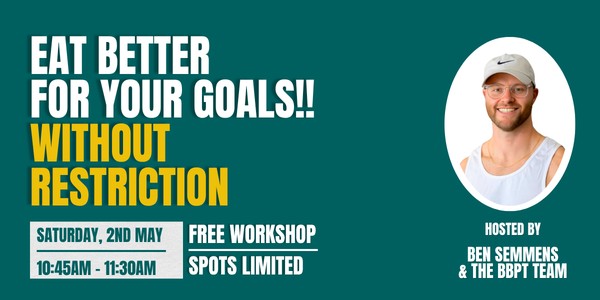
The second half is completely hands-on, so you'll walk away with practical skills you can apply straight away, and not just theory. Whether you're trying to lose weight, build muscle, improve your energy, or simply eat in a way that feels sustainable long-term, this workshop is designed to make that feel genuinely achievable.
Spots are limited, so if you've been putting off getting your nutrition sorted, this is a pretty good place to start.
Click the link here to register - I'll see you there!